
Q1:
Chemistry can be classified as a physical science because it involves the study of matter and its motion. Which of the following is not a physical science?
- A Physics
- B Astronomy
- C Earth science
- D Materials science
- E Biology
Q2:
Chemistry is involved in many aspects of our everyday lives. Which of the following processes related to making a cup of coffee does not involve chemistry in some way?
- A The diffusion of milk through the mixture of coffee and water
- B The flow of electric current to the heating element and conversion into heat energy
- C How much coffee dissolves in the water
- D The processing of coffee beans from the plant to produce the ground coffee
- E The production and properties of the ceramic cup
Q3:
A chemist may be interested in the synthesis and production of new drug molecules. Apart from chemistry, which other discipline would typically be involved in this study?
- A Metallurgy
- B Physics
- C Earth science
- D Agriculture
- E Pharmacology
Q4:
Chemistry can be partitioned into different branches. Which of the following is not a recognized branch of chemistry?
- A Inorganic chemistry
- B Physical chemistry
- C Organic chemistry
- D Analytical chemistry
- E Particle chemistry
Q5:
A company specializes in analyzing soil samples and developing new fertilizers to increase the productivity of crops. Apart from chemistry, which other discipline would this research involve?
- A Agronomy
- B Pharmacology
- C Computer science
- D Physics
- E Psychology
Q6:
A theoretical chemistry research group is studying the atomic structure of the elements and the stability of synthetic elements. Which other science discipline does this research overlap with?
- A Physics
- B Metallurgy
- C Earth science
- D Biology
- E Medicine
Q7:
Which of the following statements best describes the study of chemistry?
- A Chemistry is the study of matter and what its properties are, what it consists of, and how it changes.
- B Chemistry is the study of the mind and how it influences our behavior.
- C Chemistry is the study of matter and energy and their behavior over space and time.
- D Chemistry is the study of logic and numbers, including shapes, quantities, statistics, and arrangement.
- E Chemistry is the study of the processes that give rise to and sustain life.
Q8:
It is highly likely that ancient Egyptians developed an understanding of chemistry based on their use of different substances for which of the following practices.
- A mummification
- B medicine
- C dyeing of clothes
- D All of the answers are correct.
Q9:
Chemistry is currently applied to address and resolve many different types of environmental problems. Which of the following is not an environmental problem currently addressed by different types of chemists?
- A Contamination of water sources
- B Water shortages
- C Pollution of different soil types
- D Pollution of the air
Q10:
A research group consisting of a pharmacologist, an organic chemist, and a biologist is unlikely to study which of the following areas?
- A The synthesis of new medicines and environmentally friendly medical supplies
- B The extraction of efficient medicines from natural resources
- C The reduction of harmful gas emissions
- D The investigation of the function of enzymes
Q11:
Which branch of chemistry is interested in studying the properties of the structure of matter and the particles that form this matter?
- A Analytical chemistry
- B Nanochemistry
- C Inorganic chemistry
- D Physical chemistry
Q12:
Which branch of chemistry is most likely to study radioactivity and transformations in the nuclei of atoms?
- A Nuclear chemistry
- B Neurochemistry
- C Photochemistry
- D Inorganic chemistry
Q13:
Which branch of chemistry solves chemical problems by using methods of theoretical chemistry to create programs and run simulations?
- A Physical chemistry
- B Analytical chemistry
- C Computational chemistry
- D Organic chemistry
Q14:
In addition to engineering, which two of the following sciences would a materials scientist most likely need knowledge of?
- A Chemistry and biology
- B Chemistry and geology
- C Physics and geology
- D Chemistry and physics
Q15:
is the study of the properties of substances, their structures, and the particles which form them.
- A Biochemistry
- B Physical chemistry
- C Thermochemistry
- D Electrochemistry
Q16:
Ancient civilizations used different types of chemical reactions to produce many valuable and useful materials that helped ancient societies to function normally. Which of the following is an example of a product that was not formed through ancient chemical reactions?
- A Glass
- B Medication
- C Stone sculptures
- D Colored dye
- E Bronze metal
Q17:
Which branch of chemistry is primarily interested in the study of chemical processes within, and related to, living organisms?
- A Environmental chemistry
- B Analytical chemistry
- C Electrochemistry
- D Biochemistry
- E Quantum chemistry
Q18:
Which of the following sciences is chemistry considered a branch of?
- A Physical sciences
- B Pure sciences
- C Natural sciences
- D All of the above
Q19:
Which branch of chemistry is most likely to study the emission of greenhouse gases?
- A Inorganic chemistry
- B Organic chemistry
- C Biochemistry
- D Green chemistry
Q20:
Oceanography is the branch of science that deals with the physical and biological properties and phenomena of the sea. An oceanographer needs knowledge of all of the following sciences except .
- A Chemistry
- B Geology
- C Cosmology
- D Physics
Q21:
Chemistry could help in the production of crops through all of the following except .
- A the production of suitable fertilisers
- B the prediction of weather patterns
- C the production of efficient insecticides and pesticides
- D the chemical analysis of the soil
Q22:
Which of the following is not an example of physical science?
- A Chemistry
- B Astronomy
- C Psychology
- D Earth science
Q23:
The given graph represents the effect of temperature on the rate of one of the human digestive enzymes. Which branch of science, along with chemistry, can be most closely related to the study of digestive enzymes and enzyme reaction rates at different temperatures?
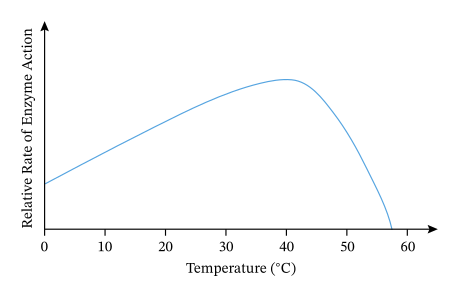
- A Agriculture
- B Metallurgy
- C Pharmacy
- D Biology
- E Physics
Q24:
Which three scientific disciplines most often work together to develop drugs for healthcare?
- A chemistry, engineering, and agriculture
- B chemistry, pharmacy, and mathematics
- C chemistry, medicine, and physics
- D chemistry, medicine, and pharmacy
Q25:
Phase changes such as boiling and melting, as well reactions that release or absorb energy, are studied in detail by which branch of chemistry?
- A Organic chemistry
- B Biochemistry
- C Thermochemistry
- D Nuclear chemistry