
Q1:
Considering the electronic configuration of iron metal represented in the diagram, what is the electronic configuration of the ion?
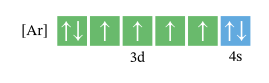
-
A
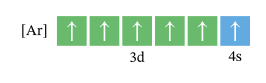
-
B
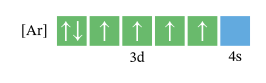
-
C
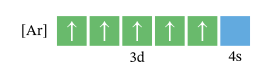
-
D
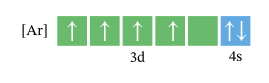
-
E
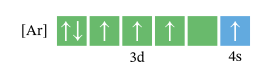
Q2:
Which of the following properties is not correct for pure iron?
- A Pure iron is easily pulled or stretched into a thin wire.
- B Pure iron has a shining luster.
- C Pure iron is very soft with low hardness.
- D Pure iron has a low melting point.
- E Pure iron has magnetic properties.
Q3:
Which of the following statements is correct?
- A Iron can be dissolved in diluted hydrochloric acid, producing iron(III) chloride and water.
- B Iron can be dissolved in diluted hydrochloric acid, producing iron(II) chloride and hydrogen gas.
- C Iron can be dissolved in diluted hydrochloric acid, producing iron(II) chloride and water.
- D Iron can be dissolved in diluted hydrochloric acid, producing iron(III) chloride and hydrogen gas.
Q4:
The red–brown precipitate shown in the picture is produced in the reaction between an iron salt and a dilute alkali solution. When the precipitate is isolated and dried and then heated in an ignition tube, water vapor was found to be present along with another iron compound, . What is a possible identity of ?

- A
- B
- C
- D
- E
Q5:
Which of the following is the resulting product from the reaction of iron with chlorine?
- A
- B
- C
- D
- E
Q6:
Which of the following is not an iron ore?
- A Dolomite
- B Hematite
- C Siderite
- D Limonite
- E Magnetite
Q7:
Magnetite is one of the most important iron ores. What is its chemical formula?
- A
- B
- C
- D
- E
Q8:
What is the most abundant transition element in Earth’s crust?
- A Copper
- B Chromium
- C Iron
- D Manganese
- E Zinc
Q9:
Which of the following is the correct balanced symbolic equation showing the reaction of iron with hot concentrated sulfuric acid?
- A
- B
- C
- D
- E
Q10:
Iron(II) oxide can be fully oxidized in dry hot air to give which of the following iron compounds?
- A
- B
- C
- D
- E
Q11:
Which of the following acids upon reaction with iron will result in the passivity of the metal?
- A Concentrated
- B Dilute
- C Concentrated
- D Dilute
Q12:
Which of the following products result from heating iron(II) sulfate?
- A Iron(III) oxide and sulfur dioxide only
- B Iron(III) oxide, sulfur dioxide, and sulfur trioxide
- C Iron metal, sulfur dioxide, and sulfur trioxide
- D Iron(II) oxide, sulfur dioxide, and sulfur trioxide
Q13:
Red-hot iron reacts with steam at a temperature of . The produced solid is then treated with hot concentrated sulfuric acid. What products are now formed?
- A Aqueous iron(III) sulfate and water vapour only
- B Aqueous iron(II) sulfate and water vapour only
- C Aqueous iron(II), iron(III) sulfate, and water vapour
- D Aqueous iron(II), iron(III) sulfate, and hydrogen gas
Q14:
Which of the following statements is true about the reaction of iron(III) oxide with hot concentrated sulfuric acid?
- A Iron metal and water vapour are formed.
- B Iron(III) sulfate and water vapour are formed.
- C Iron(III) sulfide and water vapour are formed.
- D Iron(III) sulfate and hydrogen gas are formed.
Q15:
All of the following are methods of preparation of iron(II) oxide except .
- A heating iron(II) oxalate in the absence of air
- B heating iron(II) oxalate in the presence of air
- C the reduction of
- D the reduction of
Q16:
Magnetic iron oxide reacts with hydrogen gas at a temperature range of . Which of the following products are formed?
- A Iron(III) oxide and hydrogen gas
- B Iron(II) oxide and water vapour
- C Iron(III) oxide and water vapour
- D Iron metal and water vapour
Q17:
What is the balanced equation of the reaction of iron metal with chlorine?
- A
- B
- C
- D
Q18:
Which of the following are the products of the reaction of iron metal with dilute sulfuric acid?
- A Iron(III) sulfate and hydrogen gas
- B Iron(III) sulfate, iron(II) sulfate, and water vapour
- C Iron(II) sulfate and hydrogen gas
- D Iron(III) sulfate and water vapour
Q19:
What is the correct balanced symbol equation for the reaction of magnetic iron oxide with hydrogen gas?
- A
- B
- C
- D
Q20:
When iron is treated with concentrated nitric acid, a thin oxide layer is formed preventing further reaction with the metal. Which of the following can be added to remove this layer?
- A Aqueous potassium hydroxide
- B Dilute hydrochloric acid
- C Dilute carbonic acid
- D Aqueous sodium hydroxide
Q21:
What is the name of the salt produced from the reaction of iron metal with sulfur?
- A Iron(II) sulfide
- B Iron(III) sulfate
- C Iron(III) sulfide
- D Iron(II) sulfite
Q22:
Which of the following is not true about iron(III) oxide?
- A It is insoluble in water.
- B It is found in haematite.
- C It is readily soluble in water.
- D It is used in red pigments and paints.
Q23:
Which of the following is true about iron?
- A Its melting point is higher than , and it has a high density.
- B Its melting point is lower than , and it has a low density.
- C Its melting point is lower than , and it has a high density.
- D Its melting point is higher than , and it has a low density.
Q24:
Which of the following is not true about iron(II) oxide?
- A It is found in haematite.
- B It is a black compound.
- C It is easily oxidised in hot air into iron(III) oxide.
- D It is insoluble in water.
Q25:
Which of the following reactions yields iron(III) oxide?
- A Heating iron(III) hydroxide above
- B The reaction of magnetic iron oxide with carbon monoxide at
- C The reaction of red-hot iron with steam
- D Heating iron(II) oxalate in the absence of air